
NURS FPX 6200 Assessment 4 Strategic Visioning With Stakeholders
NURS FPX 6200 Assessment 4 Strategic Visioning With Stakeholders
Student Name
Capella University
FPX6200
Professor Name
Submission Date
Strategic Visioning With Stakeholders
Slide 1:
Hi, I’m a nurse supervisor at Kaiser Permanente, my name is _________. I’m here to give you an update on our Strategic initiative to reduce wait times for our specialty outpatient clinics and provide patient-centered care.
Slide 2:
The first step necessary to achieve long-term successful transformation and realise defined operational goals is to develop a collaborative shared vision with appropriate stakeholders. At Kaiser Permanente, their planning process continues engaging executive leadership, nursing management, and direct care staff as a significant part of their project planning (involves conducting interviews with many parties) to obtain different views of all stakeholder groups and produce a coherently aligned strategic plan that captures the views represented by all stakeholder groups. Best practice research shows that the adoption of a wide array of stakeholders in developing a common vision significantly enhances the likelihood of implementation of any health care strategy. Additionally, working with stakeholders to develop and co-create a shared vision has the best transfer influence on building trust amongst all stakeholders and creating a sense of ownership and commitment to sustaining the results together over time.
Figure 1
SOAR Analysis
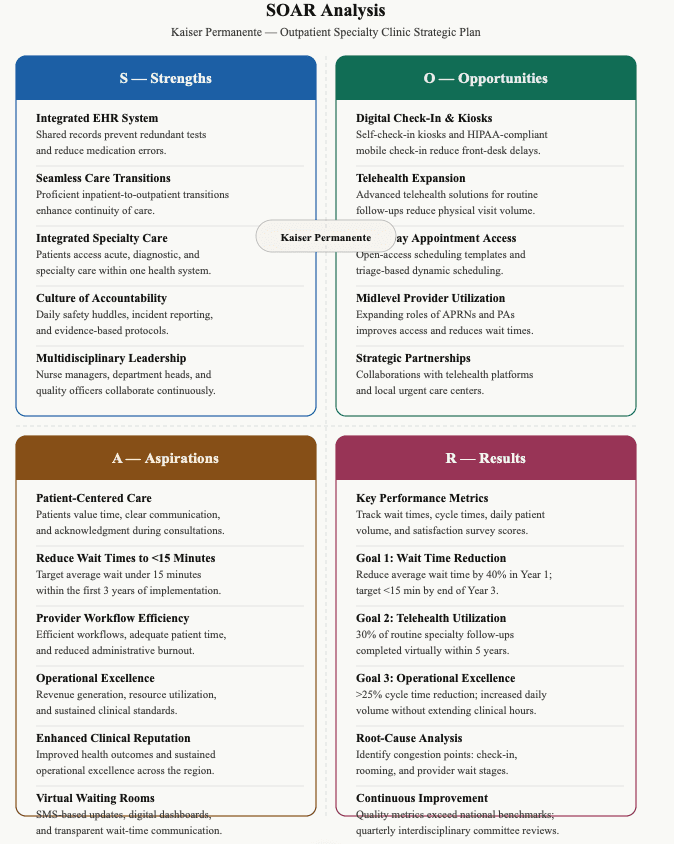
Strategic Plan Summary: Goals, Metrics, and Initiatives
Slide 3:
To reduce outpatient specialty clinic wait times to no more than 15 minutes within 3 years, after 3 years using advanced access scheduling and digital check-in; to increase use of telemedicine for routine follow up care in outpatient specialty clinics from an average of 30% at baseline to reduce demand and increase use of telemedicine in outpatient specialty clinics; to continue to improve current performance measures and hold teams accountable to operational excellence throughout the 10-year time period)There are 3 evidence-based objectives to meet increasing wait times in outpatient specialty clinics, which Kaiser Permanente is addressing.
Inherent Weaknesses and Threats
Slide 4:
A major aspect of the Strategic Planning Process is the review of the organisation’s Internal Vulnerabilities – this essentially is a comprehensive review of weaknesses within the organisation, identifying what may be holding the organisation back from achieving its objectives. In Kaiser Permanente, this will involve considering the vulnerability associated with long wait times for customers and extreme fatigue experienced by many providers, all of which could lead to less-than-optimal patient care. A wide range of impediments have been found to thwart the effectiveness of nursing professionals to become effective leaders in health care organisations, such as a high rate of excessive fatigue of individuals & teams and a shortage of qualified nursing professionals. Due to these vulnerabilities, the Strategic Plan will not be put into action or maintained until these are identified and addressed proactively.
Communicating the Plan to Stakeholders
Slide 5:
Often, stakeholder support for a successful delivery of the strategy depends greatly on the quality of communication. It must be communicated clearly, consistently, and in a variety of ways (executive update/town hall meeting/dashboard reports). To build trust and confidence among their stakeholders and to reduce barriers to change in the organisation, Kaiser Permanente leverages a variety of communication media. The issues and the messaging must be different for each group of stakeholders because they will have varying concerns (e.g., clinical vs executive) and customised messaging must be utilised to foster engagement and ongoing participation by all stakeholders.
Assumptions and Sustainability of Strategic Direction
Slide 6:
The current strategic plan also incorporates key assumptions that need to be reviewed regularly over time; the strategic plan will continue to be backed by the management and will provide a stable funding level, as well as the opportunity for employees to operate in a new way. The need for further strategic advances within healthcare is well documented and will continue to rely on leadership and the development of an ongoing plan to keep the resources flexible and long-lasting. If these assumptions are evaluated at regular intervals of time (e.g., every three months), it will enable the organisation to be adaptable to meet the changing environment of its operations and the behaviours of its employees.
Strategic Goals and Action Steps for Organizational Alignment
Slide 7:
It is crucial to implement critical actions in a sequential and intentional way to ensure that an organization’s structure, systems, and values are adjusted in line with the organization’s strategic objectives. Three basic activities that must occur to reach our strategic objective of patient-centered, coordinated care are modifying current workflows for scheduling, embedding evidence-based triage into workflow, and creating digital tools of the integrated (electronic) health record to enhance the movement of patients through our delivery system (Simpson et al, 2022). Providing patient-centred care coordination most efficiently requires a proactive and accountable structure with standardised clinical protocols to support this. Coordinate these changes with staff, who are most likely to be affected by them, to gain staff buy-in in the culture change and to reduce resistance to introducing change.
Criteria for Evaluating Orientation and Onboarding Success
Slide 8:
Evaluation for orientation and onboarding needs to be articulated so that new employees are easily able to bridge into reengineered work processes at the beginning, and evaluation for new hire success will be tied to measures of new hire performance, the length of time to become productive, and how new hires feel about their initial interactions with patients. Health care organizations have made use of structured induction that has measurable targets to better retain and perform staff. So, having quality and safety expectations in place through the onboarding process from day one of the employee’s job makes it easier to hold everyone in the organization accountable and continue striving for improvement.
Evaluating Implementation Success Against Benchmarks
Slide 9:
Success at implementing the measurement will be defined by the comparison of the actual performance to the appropriate benchmarks based on previous data collected in the setting where care is given. Kaiser Permanente will use KPIs or key performance indicators, which include: Average duration of physician wait time, number of patients seen a day, and their ability to provide same-day appointments, and surveys of patient satisfaction with the overall experience offered by Kaiser Permanente. Other studies have revealed that companies with access to live metrics of business performance can better detect weaknesses in their performance and take timely actions to address the weaknesses and maintain favourable performance. The Interdisciplinary Quality Committee will support ongoing evaluations and make quarterly strategic plan adjustments based on these evaluations for evidence-based changes.
Areas of Uncertainty and Knowledge Gaps
Slide 10:
Identifying areas of limited available data and identifying what type(s) of information are not currently available is a necessary first step in developing an effective long-term organizational strategic direction that can be adjusted as necessary. The 2 areas that the organization had some uncertainties about, due to ongoing staffing issues, were (1) the relative clinical equivalence with delivered in-person services across different specialties, and (2) the expected timeframe for sustained improvement. Additionally, it’s reported that there are a lot of frontline managers who are not equipped with the skills to use advanced data analysis techniques for effective interpretation and response to real-time operational data. Hence, the focus will be on leadership development/training programs in data literacy development to bridge gaps stemming from data and enhance the organization’s capacity to make evidence-based decisions.
Cultural, Ethical, and Regulatory Considerations
Slide 11:
Three factors will impact the creation and implementation of this strategic plan – cultural sensitivity (including ethnic and racial identity); ethical responsibility; and regulatory compliance. Kaiser Permanente’s patient population, and even its employee population, can be described as having a rich cultural history as it relates to culture. Therefore, during the redesign of the scheduling and digital communication tools, a culturally inclusive approach to both communication and input from front-line staff will have to occur so that co-design can take place. From an ethical standpoint, as the introduction and increasing reliance on digital check-in and telehealth appointments become prevalent, both methods should not impose additional barriers or obstacles to accessing either method of appointment that already exist for the elderly and low-cost patients using other means of appointment. So, some patients will still be able to have their in-person appointment. The digital communications systems must be compliant with all HIPAA requirements that are needed to ensure the privacy of patient information and to prevent unauthorized access to patient information before and after the implementation of the digital communications system.
Potential Conflicts Related to Cultural, Ethical, and Regulatory Considerations
Slide 12:
As you work on managing and planning activities competing with each other, it is important to recognize that there may be some priority conflicts that become conflict points as you move forward with the planned activities. An example of this would be that if you are using technology/digitization to create operational efficiency to deliver health care, then maybe you aren’t as accessible and perhaps are compromising on equity in access and use of new technologies that impact your ability to deliver equitable care for everyone. Some may not have access or be familiar with new technologies in the ways in which you can deliver care. While meeting the EHR requirements may lead to increased time required for adopting new technology, which can generate tension between the innovation/ creative process of providing care for the health care and the law’s requirements due to mandatory compliance, Iqbal and Andorno say. Thus, make sure that any possible conflict is addressed and resolved within an inclusive policy, and in consultation with a number of stakeholders, to maintain your ethical and operational integrity.
Nurse Leader Role and Leadership Theories
Slide 13:
Leaders of charge nurses have a key and diverse role in the success of this strategic plan at Kaiser Permanente. Motivational techniques of transformational leadership will be employed to encourage nurse leaders to support workers to embrace the new scheduling model and the digital processes used by the team to support patients. Studies have shown that transformational leadership can help organizations realize greater nurse retention and organizational innovation when they are linked to the organizational values. Also, a servant leadership approach will be used to remove systemic barriers, promote staffing levels, and develop a psychologically safe workplace that allows for the regular reporting of workflow inefficiencies.
Underlying Assumptions
Slide 14:
Various underlying assumptions are in place that were used to develop and design the strategic plan and anticipated outcomes. They are: (a) organizational leaders will have a long-term commitment to realize strategic results; (b) enough money will be provided for the realization of the strategic plan; and (c) most of the staff will respond positively to change if they are well supported. A transparent set of strategic plan assumptions has been proven to improve the organization’s flexibility in response to change and lower the risk of failed implementation. Leaders will need to keep reviewing and listening to staff on assumptions to ensure that the organisation is continuing to meet its strategic objectives in the context of a changing environment.
Advocacy for Leadership Qualities and Skills
Slide 15:
The attributes and skills needed by leaders to execute a vision for a desired future for the organization closely mirror the competencies that are needed to create a sustainable health system. Certain key skills — including digital fluency, emotional intelligence, data literacy and change management — are essential for Kaiser Permanente staff members to overcome obstacles to redesigning workflows and implementing new technologies. Healthcare leaders who are both digitally skilled and emotionally intelligent are far more likely to be successful in their work to improve patient care and to make change within their organization, Rejas says. In addition to these leadership strengths, the strategic plan will be successfully delivered across the health system with these clinical and operational leadership components.
Personal Opportunities for Growth
Slide 16:
Self-reflective growth in conjunction with investing in my personal and professional growth has been essential to my effective leadership outcomes. As I pursue this strategic plan, the following 3 items will provide guidance: improving knowledge of data analysis capabilities in relation to clinical practice, understanding telehealth governance, and developing the ability to successfully collaborate across disciplines. Higher-level development programs have been shown to increase the confidence and competence of nurse leaders in how they manage in their organization on a large scale. By continuing my education, seeking mentoring opportunities, and working towards meeting these three objectives, I believe that I will be able to build my own competency and help to establish an organizational culture of lifelong learning, with which I interact.
Conclusion
Slide 17:
Kaiser Permanente’s strategic plan will provide guidelines outlining the future improvements to outpatient specialty clinics regarding access, quality, and safety. Transformational leadership coupled with servant leadership will be a key factor in stakeholder engagement and rigorously measuring outcome results. Since this strategic plan aligns with Kaiser Permanente’s mission/values, the clinical brand of Kaiser Permanente will continue to develop along with the community trust that has been built up to this point.
Step-By-Step Instructions To NURS FPX 6200 Assessment 4 Strategic Visioning With Stakeholders
Instructions for NURS FPX 6200 Assessment 4 will be added soon.
References for NURS FPX 6200 Assessment 4 Strategic Visioning With Stakeholders
- You can use these references for your assessment.
Fedji, A., Andreassen, T. W., & Witell, L. (2026). The innovation–sustainability nexus: How communication channels shape perceptions and outcomes. Journal of Service Management, 1–21. https://doi.org/10.1108/josm-04-2025-0186
Geske, A. M., Herold, D. M., & Kummer, S. (2025). Using sustainable technology to drive efficiency: Artificial intelligence as an information broker for advancing airline operations management. Sustainable Technology and Entrepreneurship, 4(3), e100111. https://doi.org/10.1016/j.stae.2025.100111
Humbert, K., Mauldin, K., & Saarony, D. (2023). A comparative analysis of outpatient nutrition clinic scheduling outcomes based on in-person and telehealth patient care delivery modalities. Healthcare Analytics, e100163. https://doi.org/10.1016/j.health.2023.100163
Iqbal, J. D., & Andorno, N. B. (2022). The regulatory gap in digital health and alternative pathways to bridge it. Health Policy and Technology, 11(3), e100663. https://doi.org/10.1016/j.hlpt.2022.100663
Morgan, T. R., Roath, A. S., & Richey, R. G. (2023). How risk, transparency, and knowledge influence the adaptability and flexibility dimensions of the responsiveness view. Journal of Business Research, 158, e113641. https://doi.org/10.1016/j.jbusres.2022.113641
Pena, H., Kester, K., Cadavero, A., & O’Brien, S. (2022). Implementation of an evidence-based onboarding program to optimize efficiency and care delivery in an intensive care unit. Journal for Nurses in Professional Development, 6. https://doi.org/10.1097/nnd.0000000000000915
Potthoff, S., Finch, T., Bührmann, L., Etzelmueller, A., Genugten, C. van , Girling, M., May, C., Perkins, N. J., Vis, C., & Rapley, T. (2023). Towards an implementation‐stakeholder engagement model (I‐STEM) for improving health and social care services. Health Expectations, 26(5), 1997–2012. https://doi.org/10.1111/hex.13808
Rahman, M. A., Alam, M. S., & Hossain, S. (2025). How interactive dashboards improve managerial decision-making in operations management. American Journal of Advanced Technology and Engineering Solutions, 1(01), 122–146. https://doi.org/10.63125/cqm5jk84
Rarani, S. A. (2025). Nursing workforce in collapse: A narrative review of global shortages, burnout, and the future of health system resilience. International Journal of Africa Nursing Sciences, 24, e100938. https://doi.org/10.1016/j.ijans.2025.100938
Rejas, V. M. G., Kelly, J. T., Zhang, L., Marinucci, N., Payne, K., Zhou, X., Lu, Y., Smith, A. C., & Thomas, E. E. (2026). Understanding the telehealth access through an intersectional lens: Experience of Mandarin-speaking consumers accessing health services from a tertiary hospital in Australia. Digital Health, 12, e15915. https://doi.org/10.1177/20552076261415915
Simpson, K., Nham, W., Thariath, J., Schafer, H., Eriksen, M. G., Fetters, M. D., Serlin, D., Peterson, T., & Abir, M. (2022). How health systems facilitate patient-centered care and care coordination: A case series analysis to identify best practices. BMC Health Services Research, 22(1). https://doi.org/10.1186/s12913-022-08623-w
Subramani, N. R. (2021). Transformational leadership and its impact on organizational commitment during change management. International Journal of Health Technology and Innovation, 4(01), 90–101. https://doi.org/10.60142/ijhti.v4i01.13
Suriyankietkaew, S., & Kungwanpongpun, P. (2021). Strategic leadership and management factors driving sustainability in health-care organizations in Thailand. Journal of Health Organization and Management. https://doi.org/10.1108/jhom-05-2021-0165
Do you need a tutor to help with this paper for you with in 24 hours.
- 0% Plagiarised
- 0% AI
- Distinguish grades guarantee
- 24 hour delivery